Table of Contents
ToggleKeyword Research for Beginners: A Simple Guide to Finding the Right Keywords
When I first started learning SEO, keyword research was one of those topics that sounded easier than it actually was.
I used to think it was simply about finding a keyword with a good number of searches and adding it to a blog post several times. But after learning and practicing SEO, I realized there is much more to it.
A good keyword isn’t just a popular search term. It should make sense for your content, your audience, and what you are trying to achieve with your website.
In this guide, I’ll walk you through keyword research in a simple way, especially if you’re just getting started with SEO.
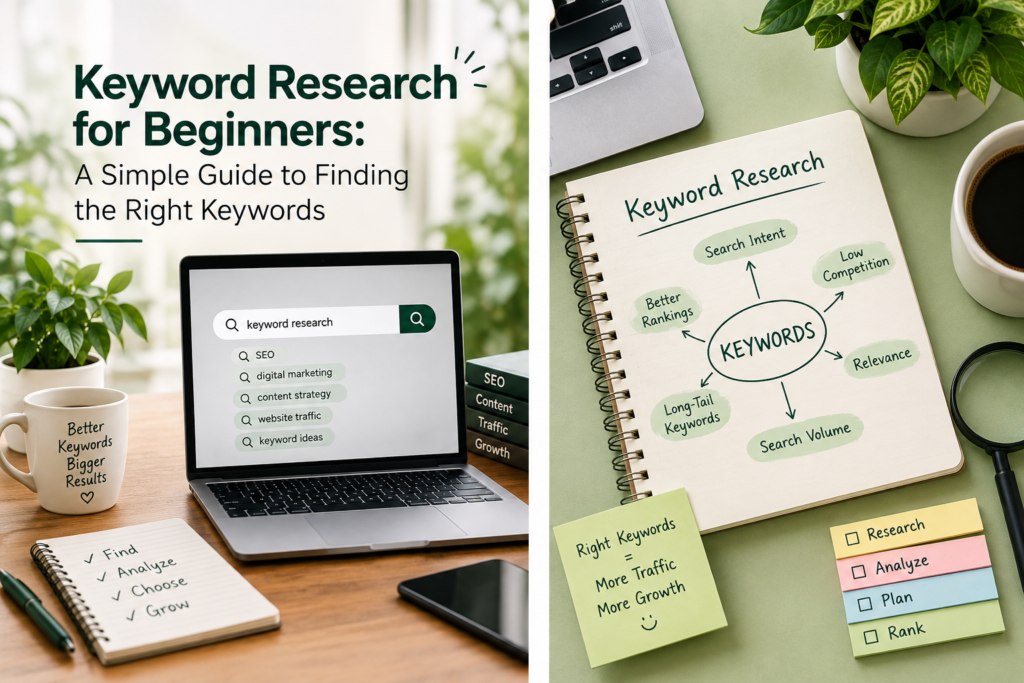
What Is Keyword Research?
Let’s keep it simple.
Whenever you type something into Google, you are using a search query. For example, you might search for:
- how to learn SEO
- SEO tips for beginners
- best digital marketing tools
- how to create a website
These words and phrases give us clues about what people want to know.
Keyword research is the process of finding and studying these search terms to understand what your audience is looking for.
For a website owner or content creator, this information can be very useful when deciding what to write about.
Instead of guessing what people might be interested in, you can use real search behavior to guide your content ideas.
Why Should You Do Keyword Research?
Imagine spending hours writing a detailed article, publishing it, and then getting very little traffic.
It can be frustrating.
One possible reason is that the topic or wording doesn’t match what your audience is actually searching for.
Keyword research can help you avoid some of this guesswork.
It can help you:
- Find topics people are interested in
- Understand the questions your audience has
- Plan blog content
- Discover specific search phrases
- Understand what users expect from a search
- Find opportunities that may be suitable for your website
But there is something important to remember.
More searches don’t always mean better results.
A keyword might have thousands of searches but be extremely competitive or completely unrelated to your business.
A smaller keyword that attracts the right audience can sometimes be much more useful.
Understanding Different Types of Keywords
When you start researching keywords, you’ll notice that they are described in different ways.
You don’t need to memorize every SEO term. Understanding the basic categories is enough at the beginning.
Short-Tail Keywords
Short-tail keywords are broad and usually contain only a few words.
Examples include:
- SEO
- Digital Marketing
- Content Marketing
- Social Media
The problem with these keywords is that we don’t always know exactly what the searcher wants.
For example, someone searching for “digital marketing” could be looking for a definition, a course, a job, an agency, or simply general information.
They can also be highly competitive.
Long-Tail Keywords
Long-tail keywords are more specific.
For example:
- digital marketing tips for small businesses
- how to learn SEO from home
- keyword research for SEO beginners
- social media marketing ideas for small businesses
These searches usually tell us more about what the person wants.
For someone starting a new website, specific keywords can sometimes be a more practical place to begin than very broad terms.
Informational Keywords
These are searches where someone mainly wants an answer or information.
For example:
- What is SEO?
- How does keyword research work?
- What is on-page SEO?
- How can I improve website traffic?
Blog posts, tutorials, and guides are often useful for these searches.
Commercial Keywords
These usually show that the person is comparing or researching before making a decision.
Examples:
- best SEO tools
- best digital marketing course
- SEO software comparison
The person may not be ready to buy yet, but they are exploring their options.
Transactional Keywords
These searches usually indicate that someone is closer to taking an action.
Examples:
- buy SEO software
- hire SEO consultant
- digital marketing course online
Knowing the difference between these searches helps you create the right type of page for the right audience.
How Do You Find Keyword Ideas?
You don’t need to open ten different SEO tools to get started.
There are some simple ways to find useful ideas.
Start With One Main Topic
First, decide what you want your page to be about.
Let’s say you want to write about keyword research.
Don’t stop at that one phrase.
Think about the questions a beginner might have:
- What does keyword research mean?
- Why do keywords matter?
- How do I find keywords?
- What tools can I use?
- How do I choose a good keyword?
- What is keyword difficulty?
Now you already have several possible directions for your content.
Use Google to Understand Your Audience
Google itself can be a useful research starting point.
Type your topic into the search bar and pay attention to the suggestions Google gives you.
You can also look at:
People Also Ask
and
Related Searches
These sections can give you ideas about the questions and related topics people are interested in.
One thing I find useful when learning SEO is not just looking at the keywords, but actually reading the search results.
The results can tell you what kind of content Google is showing for that query.
Keyword Research Tools You Can Try
Once you have some basic ideas, keyword research tools can help you investigate them further.
Some commonly used tools are:
Depending on the tool, you may find information about search volume, competition, trends, related terms, and other metrics.
If you’re new to SEO, don’t feel like you need to learn all of these tools immediately.
Start with one tool, understand what the data means, and practice using it.
That is much easier than trying to learn everything at once.
Don't Forget Search Intent
This is one part of keyword research that I think beginners should pay special attention to.
Search intent is simply the reason behind a person’s search.
Consider these three searches:
“What is keyword research?”
The person probably wants to learn the basics.
“Best keyword research tools”
The person is probably comparing available tools.
“Buy keyword research software”
Here, the person is showing a much stronger intention to purchase.
All three searches are related to the same subject, but the user’s purpose is different.
That’s why simply finding a keyword isn’t enough.
Before choosing one, search for it on Google and look at the pages that appear.
Ask yourself:
“If I target this keyword, can my page genuinely give the searcher what they are looking for?”
If yes, you’re moving in the right direction.
How Do You Decide Which Keyword to Target?
After collecting keyword ideas, you may have a long list.
So how do you choose?
I would look at five basic things.
1. Relevance
First, ask whether the keyword actually relates to your website and your content.
Don’t target a keyword just because it has lots of searches
2. Search Intent
Make sure your content matches what people expect when they search for that phrase.
3. Competition
Look at how difficult it may be to compete for the keyword.
A new website may find it challenging to compete immediately for very broad terms.
4. Search Demand
Search volume can give you an idea of how often a term is searched.
But don’t let one number make the decision for you.
5. Value to Your Website
This is particularly important for businesses.
Ask:
“If someone finds my website through this keyword, are they likely to be interested in what I offer?”
A keyword that brings 100 highly relevant visitors can sometimes be more valuable than one that brings thousands of visitors who aren’t interested in your service.
Where Should You Use Your Keyword?
Once you’ve chosen your main keyword, you can use it in the important parts of your webpage where it makes sense.
For example:
- SEO title
- Main heading
- URL
- Introduction
- Relevant subheadings
- Main content
- Meta description
- Image alt text, when appropriate
But please don’t force it everywhere.
Your reader should never feel like the same phrase is being repeated just to satisfy a search engine.
Instead, write naturally and use related words when they genuinely help explain the topic.
What About Keyword Density?
This was something I personally found confusing when I was learning SEO.
You may see people talking about keyword density and trying to reach a particular percentage.
But there isn’t a magic keyword percentage that guarantees a better ranking.
If you are constantly counting how many times you’ve used a phrase, you can easily end up with unnatural writing.
I’d rather focus on:
- Answering the reader’s question
- Covering the topic properly
- Making the article easy to read
- Using useful examples
- Organizing information with clear headings
- Adding relevant internal links
If the content is genuinely about the topic, relevant words and phrases will naturally appear.
Mistakes Beginners Often Make
Learning SEO takes practice, and making mistakes is part of that process.
Here are some common ones worth avoiding.
Picking the Keyword With the Biggest Search Volume
A high-volume keyword isn’t automatically a good target.
Competition and relevance matter too.
Ignoring What Appears on Google
Don’t rely only on a tool’s numbers.
Search the keyword yourself and see what type of content is ranking.
Choosing a Keyword That Doesn't Fit Your Website
Getting visitors who have no interest in your website isn’t the goal.
Trying to Put Too Many Keywords Into One Article
One article should have a clear main topic.
You can cover related terms naturally without trying to target every possible variation.
Writing for Google Instead of People
This is probably one of the easiest mistakes to make.
When a reader opens your article, they shouldn’t feel like they’re reading a list of keywords.
Useful content comes first.
How Keyword Research and On-Page SEO Work Together
Keyword research and on-page SEO are closely connected, but they aren’t the same thing.
Keyword research helps you understand what people are searching for.
On-page SEO is about improving the actual webpage so that the content is well organized, relevant, and easy to understand.
For example, after researching your keyword, you can work on your:
- Headings
- URL
- Content
- Images
- Internal links
- Meta description
I’ve explained these elements in more detail in my On-Page SEO: A Complete Guide to Optimizing Your Website for Google.
A Simple Keyword Research Method for Beginners
If all of this feels like a lot, don’t worry.
You can start with this simple process:
Choose a topic → Think of possible searches → Check Google → Research the keywords → Understand search intent → Compare competition → Choose your main keyword → Create useful content → Optimize the page
That’s it.
You don’t need to make the process complicated when you’re just starting.
What I Learned From Practicing Keyword Research
When I was first introduced to keyword research, terms like search volume, competition, keyword difficulty, and search intent felt like separate pieces of information.
The more I practiced, the more I understood how they connect.
For example, a keyword might have good search volume, but if it doesn’t match the purpose of my page, it may not be a good choice.
That’s why I now look at the whole picture instead of one metric.
If you’re learning SEO too, my biggest advice is simple: don’t just read about keyword research.
Try it yourself.
Choose a topic, find a few keywords, search them on Google, compare the results, and create a small piece of content around one of them.
The more you practice, the easier the process becomes.
Frequently Asked Questions
Keyword research is the process of finding and analyzing the terms people use when searching online. It helps you understand your audience and plan relevant content.
Yes. It can help beginners understand what their audience is searching for and choose more relevant topics for their website.
No. Search volume is only one factor. Relevance, search intent, competition, and the value of the keyword to your website are also important.
Not necessarily, but they are often more specific and may have less competition than broad keywords. The actual difficulty depends on the particular search term and the websites competing for it.
There is no fixed number. Start with one clear primary topic and naturally include related terms where they make sense.
Google Keyword Planner, Google Search Console, and Google Trends are good places to start. You can explore more advanced tools as you become comfortable with SEO.
Final Thoughts
Keyword research isn’t about finding a popular phrase and repeating it again and again.
It’s about understanding people.
What are they searching for?
Why are they searching for it?
And can your website give them a genuinely useful answer?
Once you start looking at keywords from that perspective, SEO becomes much easier to understand.
You don’t have to learn everything in one day. Start with one topic, research it, create useful content, see how it performs, and keep improving.
Good SEO starts with understanding your audience—not just chasing rankings.