Table of Contents
ToggleDigital Marketing: A Complete Guide for Businesses
Think about the last time you wanted to buy something, find a service, or learn about a business. Chances are, you searched online, checked a website, looked at social media, or read reviews before making a decision.
That is where digital marketing becomes important.
For businesses today, having an online presence is only the beginning. The real challenge is getting your business in front of the right people and giving them enough useful information to take the next step.
Digital marketing uses online platforms, search engines, websites, social media, content, and advertising to help businesses connect with potential customers.
In this guide, we’ll look at the major areas of digital marketing, how they work together, and how a business can start building a practical online marketing strategy.
Digital marketing helps businesses connect with potential customers through websites, search engines, social media, and other online channels.
A business might use Google to attract people searching for a solution, social media to build relationships, a website to explain its services, and paid advertising to reach a more specific audience.
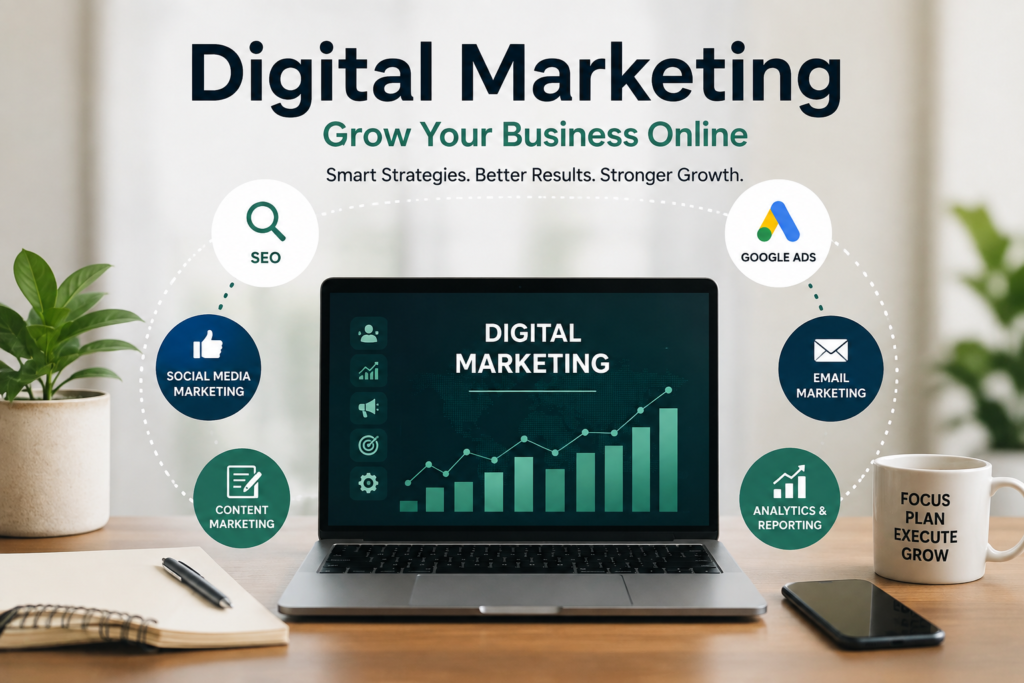
Digital marketing covers several key areas, including:
-
- Search Engine Optimization (SEO)
-
- Social Media Marketing
-
- Google Ads and paid advertising
-
- Content Marketing
-
- Email Marketing
-
- Website Marketing
-
- Local SEO
Every business needs a digital marketing approach that fits its own goals, audience, and needs. The channels you choose should depend on your customers, business objectives, industry, available resources, and budget.
Why Do Businesses Need Digital Marketing?
Before contacting a business, many customers want to learn more about it first.
They may search for the business on Google, visit its website, check social media profiles, compare alternatives, or read customer reviews.
If your business is difficult to find online, you may miss opportunities to connect with those potential customers.
A clear digital marketing plan can help a business:
-
- Become easier to discover online
-
- Reach a more relevant audience
-
- Bring visitors to its website
-
- Increase brand awareness
-
- Generate enquiries and leads
-
- Build credibility with potential customers
-
- Encourage conversions
-
- Understand marketing performance through data
Digital marketing makes it easier to monitor your performance and understand what is working.
Instead of relying only on assumptions, businesses can use tools such as Google Analytics and Google Search Console to understand website activity and search performance.
How Does Digital Marketing Work?
Digital marketing is usually made up of several connected activities rather than one individual campaign.
Imagine someone searching Google for a service they need. They find your website, read one of your helpful articles, look at your services, check your reviews, and then contact you.
In this situation, different parts of your digital presence have worked together.
A simple customer journey can look like:
Discover → Explore → Compare → Take Action → Return
Different marketing channels can support each stage.
For example:
SEO helps people find relevant pages through search engines.
Social media helps businesses stay visible and interact with their audience.
Content marketing provides answers and useful information.
Google Ads can place a business in front of people searching for specific solutions.
Email marketing helps businesses stay connected with existing subscribers and customers.
The goal isn’t to use every channel. The main focus should be on choosing channels that best match your target audience and business needs.
Important Types of Digital Marketing
1. Search Engine Optimization (SEO)
Search Engine Optimization, commonly called SEO, involves improving a website so that search engines can better understand its content and users can find relevant information through organic search.
SEO can include:
-
- Keyword research
-
- On-page optimization
-
- Technical SEO
-
- Content optimization
-
- Internal linking
-
- Link building
-
- Local SEO
For example, a digital marketer serving businesses in Ernakulam may create useful content around topics that potential clients actually search for.
SEO usually requires patience and consistency. Rankings can change because of competition, search demand, website quality, and many other factors. Instead of expecting instant results, businesses should focus on creating useful pages and improving their website over time.
Read next: SEO for Beginners: A Complete Guide
2. Social Media Marketing
Social media gives businesses a way to communicate with their audience outside their website.
Depending on the business and audience, platforms such as Facebook, Instagram, LinkedIn, or other social networks can be used to share:
-
- Educational posts
-
- Product information
-
- Behind-the-scenes content
-
- Customer stories
-
- Short videos
-
- Offers and announcements
-
- Helpful tips
However, social media marketing isn’t simply about publishing as many posts as possible.
A better approach is to understand what your audience wants to see and create content around those interests and problems.
For example, a local business could answer frequently asked customer questions through short posts or videos instead of constantly posting promotional messages.
Read next: Social Media Marketing: A Complete Guide for Beginners
3. Google Ads and Paid Advertising
Paid advertising gives businesses another way to reach potential customers online.
With Google Ads, businesses can create campaigns designed to appear when people search for relevant terms. Other digital advertising platforms can also be used to reach people based on factors such as interests, demographics, or previous interactions.
Paid campaigns can be useful when a business wants to generate visibility within a specific timeframe.
However, simply running an advertisement does not guarantee results.
Campaign performance can depend on factors such as:
-
- Keyword selection
-
- Audience targeting
-
- Ad messaging
-
- Budget
-
- Landing page quality
-
- Competition
-
- Conversion tracking
Read next: Google Ads for Beginners: A Complete Guide
4. Content Marketing
Content marketing focuses on creating valuable and relevant content that addresses the needs and interests of a specific audience.
A business can create:
-
- Blog articles
-
- How-to guides
-
- Videos
-
- Case studies
-
- FAQs
-
- Infographics
-
- Social media posts
Good content starts with the audience’s needs rather than just the company’s desire to promote something.
For instance, a web design business could publish an article explaining the important elements of a business website. Someone researching that topic may discover the business through the article and later explore its services.
This is one reason content marketing and SEO often work well together.
5. Email Marketing
Email marketing allows businesses to communicate with people who have chosen to receive their messages.
Depending on the business, emails can be used for:
-
- Newsletters
-
- Educational resources
-
- Product announcements
-
- Special offers
-
- Follow-ups
-
- Updates
-
- Customer communication
The focus should be on sending relevant information to an appropriate audience rather than sending frequent messages simply for the sake of staying visible.
A useful email should give the reader a reason to open, read, and act on it.
6. Local SEO
Local SEO is particularly useful for businesses that serve customers in a specific geographic area.
For example:
-
- Restaurants
-
- Salons
-
- Clinics
-
- Local stores
-
- Photographers
-
- Home-service providers
-
- Freelancers
Local SEO can involve maintaining accurate business information, optimizing a Google Business Profile, earning genuine customer reviews, creating useful location-related content, and keeping contact details consistent across relevant platforms.
When someone searches for a service nearby, a strong local presence can make it easier for them to discover and evaluate a business.
What Is a Digital Marketing Strategy?
A digital marketing strategy is a plan that connects your online marketing activities with specific business objectives.
Instead of randomly choosing platforms or posting content, start by asking a few basic questions.
1. What Do You Want to Achieve?
Your goal could be:
-
- Increasing website traffic
-
- Generating leads
-
- Getting more enquiries
-
- Increasing sales
-
- Building brand awareness
-
- Growing an email list
A clear goal makes it easier to decide which marketing activities are worth prioritizing
2. Who Are You Trying to Reach?
Understanding your audience is essential.
Think about:
-
- Their needs
-
- Problems they want to solve
-
- Location
-
- Interests
-
- Buying habits
-
- Online behaviour
-
- Questions they commonly ask
The more clearly you understand your audience, the easier it becomes to create relevant content.
3. What Are They Searching For?
Keyword research helps identify the words and phrases people use when looking for information, products, or services.
For example, instead of guessing what customers want, you can research relevant search terms and use those insights when planning website content.
Read next: Keyword Research for Beginners: A Simple Guide to Finding the Right Keywords
4. Which Channels Make Sense?
on your audience and your ability to maintain them consistently.
Not every business needs to be active on every digital platform.
Choose channels based
5. What Content Will You Create?
Your content should have a clear purpose.
It could educate, answer questions, solve a problem, demonstrate your experience, or help someone decide whether your product or service is suitable for them.
6. How Will You Measure Performance?
Once your strategy is running, look at the data.
Website analytics, search performance, social media insights, advertising data, and conversion information can help you understand what is working and what needs improvement.
Understanding E-E-A-T in Digital Marketing
When publishing content online, especially business and informational content, it is useful to understand Google’s E-E-A-T concept.
E-E-A-T stands for:
Experience
Expertise
Authoritativeness
Trustworthiness
E-E-A-T is not a keyword or a technical SEO setting that you can simply switch on. It is a way of thinking about the quality and credibility of content.
Experience
Experience is about demonstrating first-hand knowledge when it is relevant.
For example, a digital marketer can make content more useful by sharing practical observations from keyword research, website audits, content planning, or SEO projects.
Real examples and lessons learned can make information feel more useful than generic advice.
Expertise
Expertise means showing an appropriate level of knowledge about the topic.
Content should be accurate, clear, well-organized, and written with a genuine understanding of the subject.
If you are discussing a technical SEO topic, for example, avoid making claims that you cannot support or explain.
Authoritativeness
Authority can develop when a person or business becomes recognized as a reliable source of information within its area.
Useful content, relevant professional experience, credible references, and recognition from other reputable sources can all contribute to how authority is perceived.
Trustworthiness
Trust is especially important when someone is considering contacting a business or spending money.
A trustworthy website should make important information easy to find and should avoid misleading claims.
Clear business details, contact information, transparent service descriptions, accurate information, and genuine customer experiences can all help create a more trustworthy online presence.
—
How SEO and Content Marketing Support Each Other
SEO and content marketing are different, but they can work together effectively.
SEO helps your website become more discoverable for relevant searches, while content gives visitors useful information once they arrive.
A simple process could look like:
Understand the audience → Research topics → Create useful content → Optimize the page → Promote it → Measure performance → Improve
For example, if customers frequently ask how to choose keywords, a business can create a detailed guide answering that question. The page can then be optimized around relevant search terms and connected to other related articles.
This approach is more useful than creating content simply because a keyword has been identified.
—
Common Digital Marketing Mistakes to Avoid
Starting digital marketing without a clear plan can lead to wasted time and money.
Trying to Be Everywhere
You don’t have to maintain every social media platform. Focus on the channels where your potential customers are most relevant.
Measuring Success Only Through Followers
Followers can be useful, but they don’t tell the whole story. Depending on your objective, website visits, enquiries, leads, sales, engagement, or conversions may provide more meaningful information.
Expecting Immediate SEO Results
SEO often takes time. Publishing one article or making a few changes does not guarantee a quick ranking improvement.
Publishing Without Understanding the Audience
Content created without knowing what people actually need may receive little attention. Research customer questions and problems before planning topics.
Ignoring Website Experience
Getting visitors to a website is only part of the job. If the website is confusing, slow, difficult to navigate, or missing important information, visitors may leave without taking action.
Failing to Track Results
Without measurement, it becomes difficult to know whether your marketing efforts are contributing to your business goals.
—
How to Start Digital Marketing as a Beginner
You don’t need a large team or complicated strategy to begin.
Start with the basics:
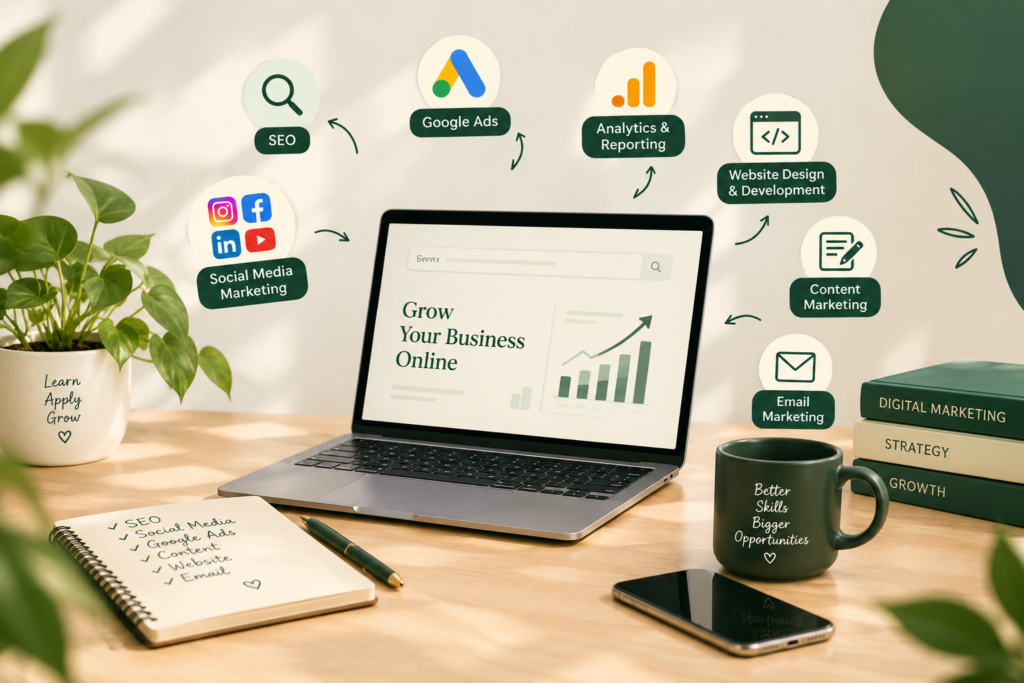
Step 1: Set one or two clear business goals.
Step 2: Define your target audience.
Step 3: Research relevant keywords and customer questions.
Step 4: Make sure your website provides clear information about your business.
Step 5: Improve important pages using basic SEO practices.
Step 6: Choose the social platforms that are relevant to your audience.
Step 7: Create useful content consistently.
Step 8: Consider paid advertising when it matches your goals and budget.
Step 9: Track traffic, engagement, leads, and conversions.
Step 10: Use the data to improve your strategy instead of simply repeating the same activities.
Frequently Asked Questions About Digital Marketing
Digital marketing is the use of online platforms and digital channels to help a business promote its products or services, reach potential customers, and build relationships with its audience.
It can help businesses become more visible online, connect with relevant audiences, generate leads, communicate with customers, and understand marketing performance through measurable data.
Common areas include SEO, social media marketing, content marketing, Google Ads, email marketing, website marketing, and local SEO.
There is no fixed timeframe. SEO and content strategies often require consistent work over a longer period, while paid advertising can generate visibility more quickly. Results depend on factors such as competition, industry, budget, audience, website quality, and implementation.
SEO and Google Ads work differently. SEO focuses on organic search visibility, while Google Ads provides paid visibility. A business may use one or both depending on its goals, budget, and timeframe.
Start by defining your goals and audience, improving your website, researching relevant keywords, creating useful content, using suitable social platforms, and measuring the results of your activities.
Final Thoughts
Digital marketing doesn’t mean being active on every platform or following every new online trend.
A strong approach starts with understanding your customers.
Find out what they need, where they search for information, what questions they have, and what makes them trust a business. Then choose the digital channels that can help you reach them.
For a small business, even simple steps such as improving website content, creating useful social media posts, optimizing local information, and tracking website performance can create a stronger foundation.
Digital marketing is an ongoing process. Test, measure, learn, and improve rather than expecting one campaign or one platform to solve everything.
When your marketing focuses on helping the right people and building genuine trust, your online presence becomes more useful to both your audience and your business.
Explore More Digital Marketing Guides
SEO for Beginners: A Complete Guide
Keyword Research for Beginners: A Simple Guide to Finding the Right Keywords
* **Social Media Marketing: A Complete Guide for Beginners**
* **Google Ads for Beginners: A Complete Guide**